Home » Course Review

Some day, some one will rescue the great course at Mullet Bay

Bookmark Related Comment
Cynthia Boal JanssensBy Cynthia Boal Janssens,
Staff Writer

Mullet Bay Golf CourseST. MAARTEN, Netherlands Antilles - We had been warnedthat the Mullet Bay golf course was not in great shape, but I don't think wewere prepared for the travesty that it has become. It's just too bad.

In the 1970s and 80s, the 600-room Mullet Bay Resort &Casino was one of the finest resorts in the Caribbean. As described in oneguidebook:

Mullet Bay is a golf and tennis Shangri-La with its sprawlingpalm-studded 18-hole course and 16 all-weather courts. Virtually a town untoitself, this community of fully outfitted condos and suites has an excellentbeach . two pools, many shops, a disco and grand casino - and sixrestaurants, running the culinary gamut from Italian to Chinese to pubfare."

I well remember driving through the complex on my first visit to St.Maarten/St. Martin, the lovely leeward island that is shared by the Dutchand the French. The Mullet Bay golf course was so popular that you needed tostay at the resort just to get on.

But on the evening of Sept. 4, 1995, Hurricane Luis slammed into theisland with 140 mph winds that gusted up to 165. As the stormabated in the early morning hours of Sept. 6, the shell-shocked islandersemerged from their shelters to face utter devastation. Many houses had beendemolished, resorts were leveled, some 95 percent of the boats around theisland had been sunk or run aground and every scrap of vegetation wasstripped away.

Mary and Tom SmithMary and Tom Smith remember it well. Recently retired from National Geographic magazine, they had just moved from the States to their dream home on St. Martin (the French side) in July. "We spent three days in the utility room under house and wondered when it would ever stop," Mary explained. "Many still refer to it as the 'storm of the century.'"

The lovely golf course at Mullet Bay was laid waste as well, stripped ofits palms and with most of the condos along its fairways left withoutwindows or roofs.

But while the rest of the island immediately began rebuilding, Mullet Bay's owners held back. Who knows precisely what the actual situation is, butSun Resorts owns the majority of the property, including the golf course,while the condominiums were controlled by their owners. Sun Resorts wants toconsolidate the condos into multiple-story buildings while the condo ownerswanted the resort returned to its pre-Luis conditions, with the unitsscattered along the fairways. It has been tied up in courts ever since.

The result is that while the island is bustling, with construction goingon everywhere and visitor arrivals at record highs, almost 10 years laterMullet Bay Resort & Casino still lies in ruins.

Except for the golf course. That remains open because of an arrangementwith the government that the course would always been kept open. (It is theonly golf course on the prosperous island that has a population of 216,500.)

We arrived at Mullet Bay via a cruise ship, the Sea Dream 2 . Wehad decided on this cruise to play as many courses as we could along theway, setting up our own tee times. But when we tried to reach the Mullet Baycourse via e-mail, we ended up finding the St. Maarten Golf Association. Wee-mailed that group and were answered by the Smiths.

Tom is the tournament chairman for the SMGA and he and Mary have beenplaying the Mullet Bay course for over 25 years. They offered, via e-mail,to play the course with us.

It was great that they did. Through their eyes, we were able to see theway Mullet Bay had been and its potential for the future. But, for now, itis obvious that just keeping it up is a struggle, mostly a labor of love forthe SMGA members.

"See those tee blocks?" Tom points. "I made and painted them all - andthen almost lost them when some workers were burning debris!" They areunremarkable, just painted blocks of wood. But they surely represent thespirit of those locals who love the Mullet Bay course.

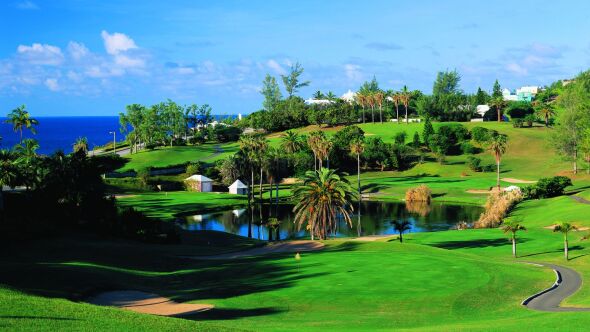
The day we played it was windy and rainy, but it was still obvious thatthis had been a great course. Designed by Joseph Lee, the par-71 coursewinds around the Mullet Bay Lagoon (just off the Simpson Bay Lagoon wheresome 1,400 boats were sunk during Luis) with views of Cupecoy beach. Itplays 6,200 yards from the back tees, 5,514 from the whites and 5,050 fromthe reds.

There is not much point in describing the course in great detail because it is in such unfortunate condition. The greens are spotty, the fairwaysuneven. There is no irrigation. All along the way are the carcasses ofcondos, stripped but still the bones are there. There are only 12 cartsavailable. For me, all this is hard to ignore, but not for Mary.

Tee Boxes"I hardly notice it any more I'm so used to it," she explains. She and Tom play golf here several times a week, usually walking. "I remember how it was, and hope that someday it will be so again. All in all, it is still a great course to play," she says.

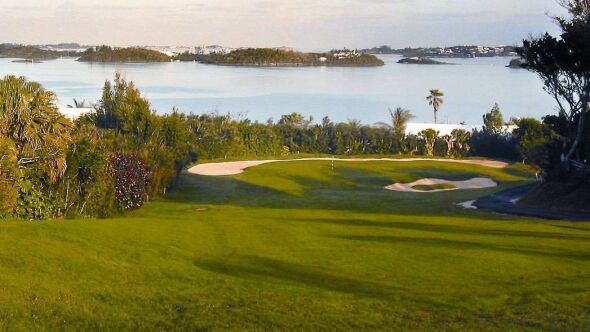
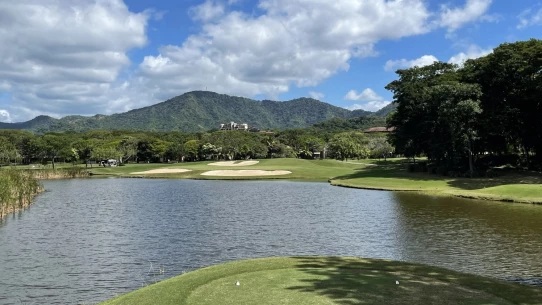
At the signature hole, No. 12, we certainly can appreciate the design.This dogleg right over water is a challenge and offers dramatic views fromthe tee. Mary explains that most of the greens used to be surrounded byeither palms or lovely flowers.

To be fair, the course is maintained to the extent that it is mowed,there is signage along the way, some sand in the bunkers and there are pinsin the holes.

Yet the pride remains for these ex-pats. There is a catch basin near thetee of No. 14. Black plastic sprawls around the rim, yet there is a smallisland in the water and we notice numerous sea birds. "We think it is neatthat this area, once pretty desolate, now attracts wildlife," Mary says. "Wehave planted water lilies in there and are trying to make it moreattractive."

Tom speaks of the fact that the course is going to host a Caribbeantournament within the month and of the ambitious preparations that areunderway. This kind of pride and determination is what will assure thefuture of this course.

The Smiths, and most everyone else on St. Maarten, are hoping that MulletBay will soon be restored to its former glory, including the golf course. Wecouldn't agree more.

Orientation

St. Maarten or St. Martin is a Caribbean Island in the northern WestIndies. For it's relatively small size, 38 square miles, this island hasmore flights from U.S. and foreign gateways than any other in this region.The major cities are Phillipsburg on the Dutch side and Marigot on theFrench side. There is only one airport, located near Phillipsburg. OrientBeach, perhaps the most famous clothes-optional beach in the Caribbean, ison this island..

Where to stay

Hard decision. The larger resorts are on the Dutch side while the Frenchside has many smaller hotels and guest houses. The Dutch side is morecommercially developed while the French side is laid back. Timeshares andvilla rentals are plentiful. It is best to rent a car while staying here soas to explore the entire island. The Towers at Mullet Bay adjoin the golfcourse and are now timeshares (discounted golf fees apply).

Where to dine

The small town of Grand Case on the French side offers some of the mostexquisite dining in the Caribbean. There is one lovely restaurant afteranother on the tiny main street where you can linger a couple of hours overlunch with wine and easily drop $150 per couple. We recommend napping on abeach after such a repast. If you are staying on the Dutch side, be wary oftoo much wine at dinner in GC because of the precarious ride back over thehills on narrow roads. In Phillipsburg, be sure to experience an authenticIndonesian rijstaffel (as many as 20 dishes, all served withsteamed white rice).

The verdict

The real estate is so valuable that someone, if not the current owner,will certainly rescue Mullet Bay Resort & Casino soon. In the meantime,playing the Mullet Bay course when you are on the island is still a funthing to do, especially if you have visited the island before. However, thefees are stiff for the quality of play ($88 with cart, $52 with pull cart).

Fast fact

The divided status of St. Maarten/St. Martin is a result of a colonialtug-of-war between European powers. The Dutch part is administered fromCuracao while the French part from Guadaloupe. There is complete freedom ofmovement on the island.

Cynthia Boal Janssens is a former newspaper writer and editor turned freelance writer. She is the former travel editor and Sunday magazine editor of The Detroit News. In addition, she has worked for newspapers in California, Georgia, New York and Pennsylvania. She is a graduate of Ohio University.

Any opinions expressed above are those of the writer and do not necessarily represent the views of the management.

 
Reader Comments / Reviews Leave a comment