


Sandals St. Lucia Golf & Country Club at Cap Estate

Rating Snapshot


About
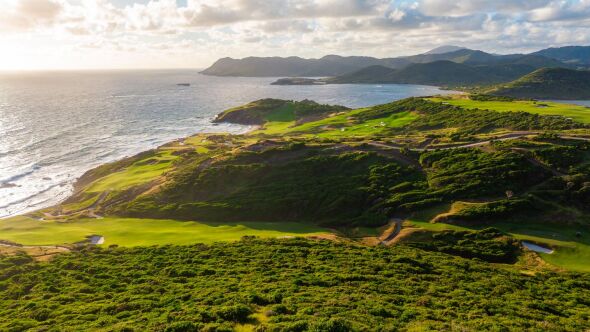
Situated at the island's northern tip, Sandals St. Lucia Golf & Country Club at Cap Estate sprawls across a lush tropical landscape that contrasts beautifully with the sparkling blue waters of both the Caribbean Sea and the Atlantic Ocean. The course enjoys a beautiful landscape where colorful orchids and bromeliads grow wild across rolling hills. It is no surprise that the golf course is also home to a variety of native wildlife. The natural contours of the land shape all of the holes, providing uneven lies, elevated greens, and undulating fairways. Golfers are quickly confronted with the course's challenges with a tricky par-4 opening hole. A water hazard guards the right side of the fairway and there are out-of-bounds to the left. In addition to the course, Sandals St. Lucia Golf & Country Club at Cap Estate also has a driving range with bunkers and a putting green.
| Tee | Par | Length | Rating | Slope |
|---|---|---|---|---|
| Blue | 71 | 6744 yards | 74.3 | 138 |
| White | 71 | 6325 yards | 72.4 | 135 |
| Red (W) | 71 | 5285 yards | 72.4 | 129 |
| Hole | 1 | 2 | 3 | 4 | 5 | 6 | 7 | 8 | 9 | Out | 10 | 11 | 12 | 13 | 14 | 15 | 16 | 17 | 18 | In | Total |
|---|---|---|---|---|---|---|---|---|---|---|---|---|---|---|---|---|---|---|---|---|---|
| Black M: 73.9/129 | 516 | 633 | 200 | 403 | 375 | 411 | 161 | 556 | 364 | 3619 | 490 | 478 | 392 | 382 | 165 | 468 | 433 | 157 | 446 | 3411 | 7030 |
| Blue M: 69.7/119 | 490 | 538 | 167 | 390 | 362 | 405 | 146 | 493 | 355 | 3346 | 441 | 462 | 365 | 359 | 139 | 438 | 386 | 149 | 410 | 3149 | 6495 |
| White M: 68.2/115 | 472 | 445 | 153 | 315 | 344 | 336 | 129 | 452 | 335 | 2981 | 418 | 451 | 318 | 307 | 121 | 407 | 332 | 113 | 368 | 2835 | 5816 |
| Red W: 65.9/107 | 410 | 422 | 104 | 262 | 248 | 285 | 123 | 327 | 239 | 2420 | 347 | 375 | 218 | 291 | 103 | 369 | 303 | 82 | 335 | 2423 | 4843 |
| Handicap | 13 | 17 | 5 | 11 | 7 | 1 | 15 | 3 | 9 | 12 | 4 | 10 | 14 | 16 | 2 | 8 | 18 | 6 | |||
| Par | 5 | 5 | 3 | 4 | 4 | 4 | 3 | 4 | 4 | 36 | 5 | 4 | 4 | 4 | 3 | 4 | 4 | 3 | 4 | 35 | 71 |
| Handicap (W) | 5 | 7 | 15 | 9 | 13 | 1 | 11 | 3 | 17 | 12 | 4 | 16 | 8 | 14 | 2 | 10 | 18 | 6 |
Course Details
Rentals/Services
Practice/Instruction
Policies
Food & Beverage
Bar, Grill, RestaurantAvailable Facilities
Banquet FacilitiesReviews

Rip Off
Conditions were so bad, cabbage fairways, bare patches everywhere, lumpy sparse tee boxes, and greens like rough concrete. The rental clubs were garage sale specials - the grips inraveled on 2 of my wifes clubs, and my "Taylormades" were 15 yr old models, so dented and beat up they looked like they were used for landscaping. We saw the beverage girl 1 time (on #1) and never again. No towels, no ball washers, no hole diagrams on the markers Icing on the cake was #18 was "under repair" (as the rest of the course should be) so we had to replay #1 to finish. At $175 per 18, $30 club rental, and $50 cart, we paid almost $1000 for a foursome for a most un-resort like experience. In the states, this would be a $20 dog track at best. If they're looking for grace because of Covid, then don't charge premium resort rates for conditions this poor. Save your money and avoid this shameful rip-off.


Thank You, I will cancel our Sandals Golf Trip!