Royal Westmoreland: Transformation in Barbados
By Dale Leatherman
BARBADOS (March 19, 2003) -- To fully appreciate the beauty of
Barbados'
Royal Westmoreland course, play it late in the day. That's when
Robert
Trent Jones Jr.'s Caribbean
creation looks as if the designer worked with oils on canvas rather
than stone, grasses and water on an old sugar plantation and rock
quarry.
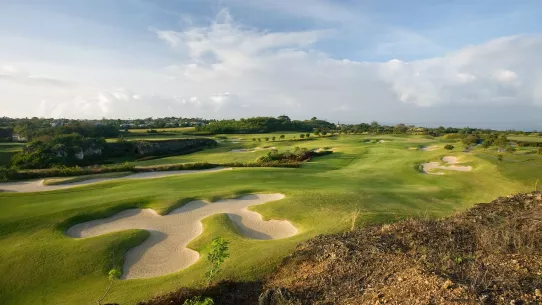
The course, which opened in 1995, occupies a canyon-riddled plateau
200 to 300 feet above sea level on the island's west coast. Come afternoon,
shadows deepen in the ravines, then edge into cloverleaf bunkers and
bring mounds and swales into sharp definition. In contrast to smooth
green fairways, tall brown feather grass ripples in the prevailing
trade wind. Flowering shrubs and trees provide bright spots of orange,
red and yellow.
Like make-up artfully applied, Jones' work has brought out the
land's best features. Nature does the rest, closing each sunny day
with a sunset show of oranges, purples and magentas behind luminous
clouds. Chance adds one more artistic touch, a white triangle of
sail on the smooth blue of the Caribbean.
Breathtaking, yes, but beneath the beauty of Royal Westmoreland
lies a beast of a golfing challenge. There are many long carries
over inhospitable terrain and that pretty feather grass gobbles
errant shots. There's not an abundance of water, but where it is,
it counts. Wind is a constant, invisible hazard, and of whimsical
velocity. Fortunately, the designer placed four or more tee boxes
on each hole to allow players to adjust the challenge to their pleasure.
Time it right and you'll finish your round in time to catch the
last of the sunset on the clubhouse terrace over a bottle of locally
brewed Banks beer. There, conversation often turns to signature
holes. There isn't one -- but there could be half a dozen.
The
par threes, for instance, are four of the best short holes in the
Caribbean.
The third hole plays toward the ocean, dropping 171 yards to a greased-lightning
green perched on the edge of a cliff and fronted by rock outcroppings
and sand bunkers. It's the "Monkey Table" hole, taking
its name from the gallery of monkeys who gather to watch humans
at play.
After the first five holes, the route turns away from the ocean,
and quarry pits provide challenge and visual impact. One of these
is the sixth, a likely signature hole. The "Hermit Hole"
takes its name from a recluse who was discovered living in an abandoned
cement mixer during the course construction. The 327-yard par four
doglegs to an elevated, sloping green surrounded on three sides
by high quarry walls. It's the shortest par four on the course,
but by no means a pushover.
The seventh hole, another devilish par three, calls for a 161-yard
carry across a water-filled quarry pit to a shallow green sloping
right to left, with the wind. It cost $50,000 to seal the porous
bottom so that water would stay in the quarry, and, as one Brit
said, "it's worth every cent."
The winsome front nine leads to a daunting back nine. Positioned
high on a ridge, the second act opens with a par four doglegging
from a high tee along a deep ravine. This insidious gully comes
into play on three more holes. On the par-three, 198-yard twelfth
hole, a direct shot to the pin means braving the void.
The par-three fifteenth hole is the most scenic shot on the back
nine. The tee is cut into the slope of the ridge, with a 209-yard
carry across jungle-like rough to a green protected on the front
and side by the omnipresent ravine. This gorge flanks the par-four,
451-yard eighteenth hole, then cuts across the fairway 20 or 30
yards from a paltry green. The fourth-ranked finishing hole drops
like a ski slope toward the white, sail-like roof of the clubhouse.
Ocean fills the horizon.
There can be no doubt that Jones is as at home in the Caribbean
as his father, who designed many island classics. With big bucks
and modern technology at his command, the son has created four terrific
island courses in recent years -- Four Seasons Nevis, Aruba's Tierra
del Sol, the Reef Course on Grand Bahama Island, and Royal Westmoreland.
But only Royal Westmoreland has the unique British/Bajan flavor
of Barbados, an island strongly loyal to the Crown since the 1600s,
yet softened by sea and sun. The golf club, too, is impeccably British,
but with island warmth. The open-air restaurant is hospitable, with
excellent food and service.
Like Barbados, Royal Westmoreland targets a decidedly upscale,
predominately British market (though Americans such as Kevin Costner,
Phil Donahue, Whitney Houston,
former Vice-President Dan Quayle and former President Ronald Reagan
have had no trouble finding the island).
If You Go:
Royal Westmoreland Golf and Country Club (246) 422-4653
Website: www.royalwestmoreland.com
Greens Fees: $75-$140 for villa renters, $100-$190 for visitors
(February 2003 prices)
Stay and Play
- Royal Westmoreland villas can be rented by the week (completely
furnished). The low season rate is $1,750 USD (2003) for a two-bedroom
unit. Renters get discounted golf rates.
- Two nearby Fairmont hotels (www.fairmont,com) offer golf packages.
Royal Pavilion and Glitter Bay sit side-by-side on the west coast,
five minutes from the golf club. Both hotels are comfortable,
with beautiful beaches, and share all water sports. The atmosphere
at Glitter Bay is more refined (think afternoon tea), with landscaped
gardens with fountains. It also has a fine spa/health club. Either
resort can be reached at (246) 422-5555.
- Sandy Lane Resort (www.sandylane.com) is a luxurious Barbados
fixture which opened in 2001 after a massive rebuilding. It has
27 holes of golf by Tom Fazio and another 18-hole course opening
in spring 2003.
Where to Dine
- Chinese - Guang Dong
- French - Ile de France, Jenner, Carambola
- Italian - Luigi's Restaurant, Bellini's Trattoria
- International - Bambas Beach Bar & Restaurant, Café
Sol, Champers, Royal Pavilion's Piperade Restaurant, Glitter Bay's
Palm Terrace
- Caribbean - Angry Annie's, Atlantis Hotel Restaurant, Boucan
- Seafood - Crane Seafood Restaurant, Lone Star Garage Restaurant,
Pices, Round House Inn
- For lunch -- Bonito Beach Bar & Restaurant, Captain's Carvery
Recreation and Sightseeing:
- Shopping. There are numerous high quality, tax-free stores (duty-free
prices typically are 30-50% less than in Europe or America). The
main shopping is on Broad Street in the capital city of Bridgetown.
It has large department stores and duty free shops. There are
smaller malls outside of town. Smaller towns (Holetown, Speightstown)
have fine craft and gift shops. Chattel Village shopping areas
throughout the island offer souvenirs, gifts, clothing, and local
arts and crafts.
- Water sports. Every resort and many private outfitters offer
diving, windsurfing, sailing and snorkeling.
- Attractions. Andromeda Botanical Gardens, Animal Flower Cave,
Coral Caves & Underground Lakes, the Flower Forest, Harrison's
Cave, Holetown, St. James Parish Church, Welchman Hally Gully,
Morgan Lewis Sugar Mill, and the Wildlife Reserve. Guests can
also enjoy horseback riding, as well as watching polo, cricket
and horseracing. Throughout the year there are also many small
town festivals and celebrations. Check when you arrive to see
what is going on.
How to Get There:
American Airlines, BWIA, and Air Jamaica offer service to Barbados,
the Caribbean's easternmost island, through Miami and San Juan.
Course Reviews & Features
|